Is the gluten-free claim on Cari0 approved by Health Canada, and could the xylitol be cross-contaminated with wheat or oats?
‘Gluten free’ is information, not a health claim, so it doesn’t require Health Canada approval (a claim relates to function, e.g. ‘helps reduce cavities’). There is no cross-contamination of the xylitol or other ingredients with gluten.
If I have a healthy biofilm but snack often on cariogenic foods, can my S. mutans levels rise to a cariogenic level?
If you use Cari0 for at least three months, its antibacterial action stabilizes S. mutans levels and helps prevent the caries process from starting. Without it, refined sugar stimulates cariogenic bacteria and levels can rise.
Why doesn't Cari0 contain fluoride?
The strategy is intentional. Earlier trials mixing xylitol and fluoride showed no synergy, so there is no reason to combine them; fluoride also doesn’t provide the sustained effect that Cari0 does, doesn’t change a patient’s caries risk, and isn’t natural. Leaving fluoride out also serves patients who avoid it, prefer natural products, or are very young (0-2), where ingestion is a concern.
Is Cari0 more effective than the recommended dose of xylitol in gum or mint form?
Cari0 uses less daily xylitol than gums/mints (about 0.5 g/day from twice-daily brushing versus roughly 10 minutes of chewing several times a day). It has demonstrated a therapeutic effect on carious lesions (~60%), changes the odds of infection and the individual’s caries risk, offers additional benefits, and fits naturally into a daily routine. Gums and mints show an antibacterial effect but no demonstrated caries-therapeutic effect in a randomized trial, involve higher cost and discipline, and can’t be used safely in early childhood.
Should Cari0 be used twice or three times a day? The instructions say three times.
The research designs used twice-daily brushing. The literature shows a large effect difference between 1 and 2 brushings but only a small difference between 2 and 3, and average daily brushing frequency tends to be twice a day, so twice daily is effective.
Does CariFree address different bacteria for root, subgingival, and interproximal decay, as a competitor claims?
There is no published research supporting CariFree’s claims, and searching scientific databases for ‘CariFree’ returns no results, whereas ‘xylitol and cariogenic bacteria’ returns many publications. Their pH-neutralizing rationale is questionable because oral pH varies constantly, is individual, and isn’t supported by evidence.
What is the scientific evidence behind Cari0?
Unlike most dental products with only in-vitro evidence, Cari0 has in-vivo evidence from about 300 participants across four studies. A 24-month randomized controlled trial of 201 mother-infant dyads found the test group had 60% fewer lesions, with significant reductions in cavitated (80%) and initial (40%) lesions. An observational study of 43 high-risk adults over 3 months of brushing showed marked drops in S. mutans infection levels, and a study of 35 high-risk schoolchildren showed a significant, sustainable antibacterial effect appearing after three months of brushing and lasting at least six months.
What does 'antibacterial for caries' mean?
In the caries process, mutans streptococci (MS) initiate a lesion and lactobacilli (L) aggravate it. The literature identifies about 10^5 MS per ml of saliva as the key threshold that shifts the process, so caries antibacterial agents aim to reduce bacteria below that level. Many high-risk patients are highly infected.
Is Cari0 certified by Health Canada?
Yes, it holds a licence supporting its marketing, which may matter to some professionals. The product licence number assures consumers it has been reviewed and approved by Health Canada for safety and efficacy.
Where does the xylitol come from?
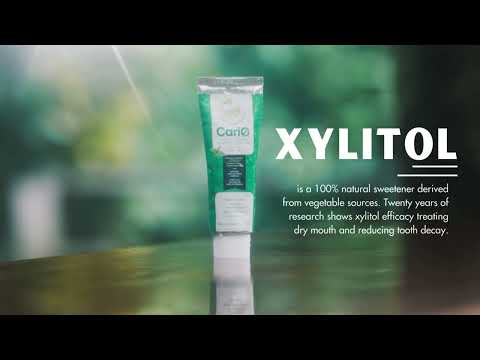
Xylose is extracted directly from birch bark or corn (the product uses an ecologically grown cotton/corn source from the US), then converted to commercial xylitol by hydrolysis and hydrogenation.
Who should use Cari0, and from what age?
Anyone concerned with caries risk: babies (avoiding early-childhood confusion and fluorosis risk from ingestion), young children, pregnant women and parents (reducing S. mutans transmission), adults, and health-conscious, vegetarian, or vegan users. It can be started as early as gum stimulation is relevant, since there is no ingestion issue, and can be applied on a wipe or by gentle brushing.
Is there any adverse or toxicity concern with Cari0?
Xylitol’s laxative threshold is roughly 70-200 g/day for adults and about 40 g/day for children, while each brushing delivers only about 0.25 g (twice daily). Even swallowing a full tube stays well within safe limits, so the toxicity risk is very low.
Any concern for people with allergies or diabetes?
Potential allergy risk applies only to patients with a known birch or corn allergy, though there is no evidence that birch- or corn-pollen-allergic patients can’t take xylitol. For people with diabetes, consuming up to about 10 g/day of sugar alcohols does not appear to cause adverse effects.
Are there other conditions Cari0 could help with?
Xylitol has shown roughly a 20% preventive fraction for acute otitis media (a common childhood bacterial infection) in a Cochrane review. An observational periodontal study also showed Cari0 significantly reduced high- and moderate-risk periodontal bacteria.
How is Cari0 different from other 25% xylitol toothpastes like XyliWhite?
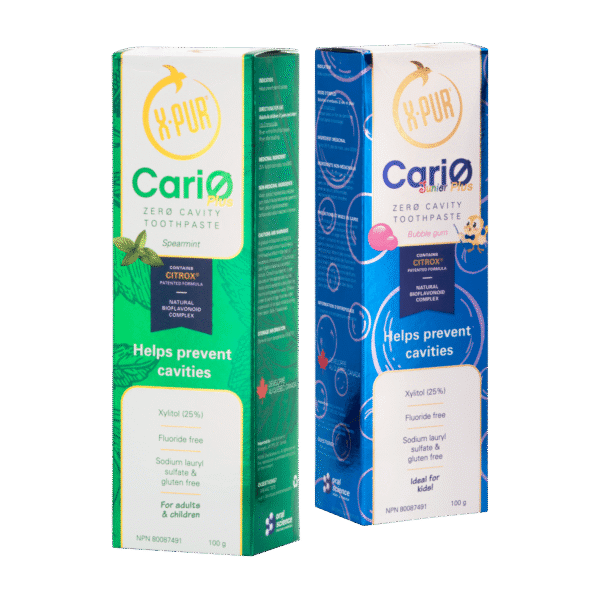
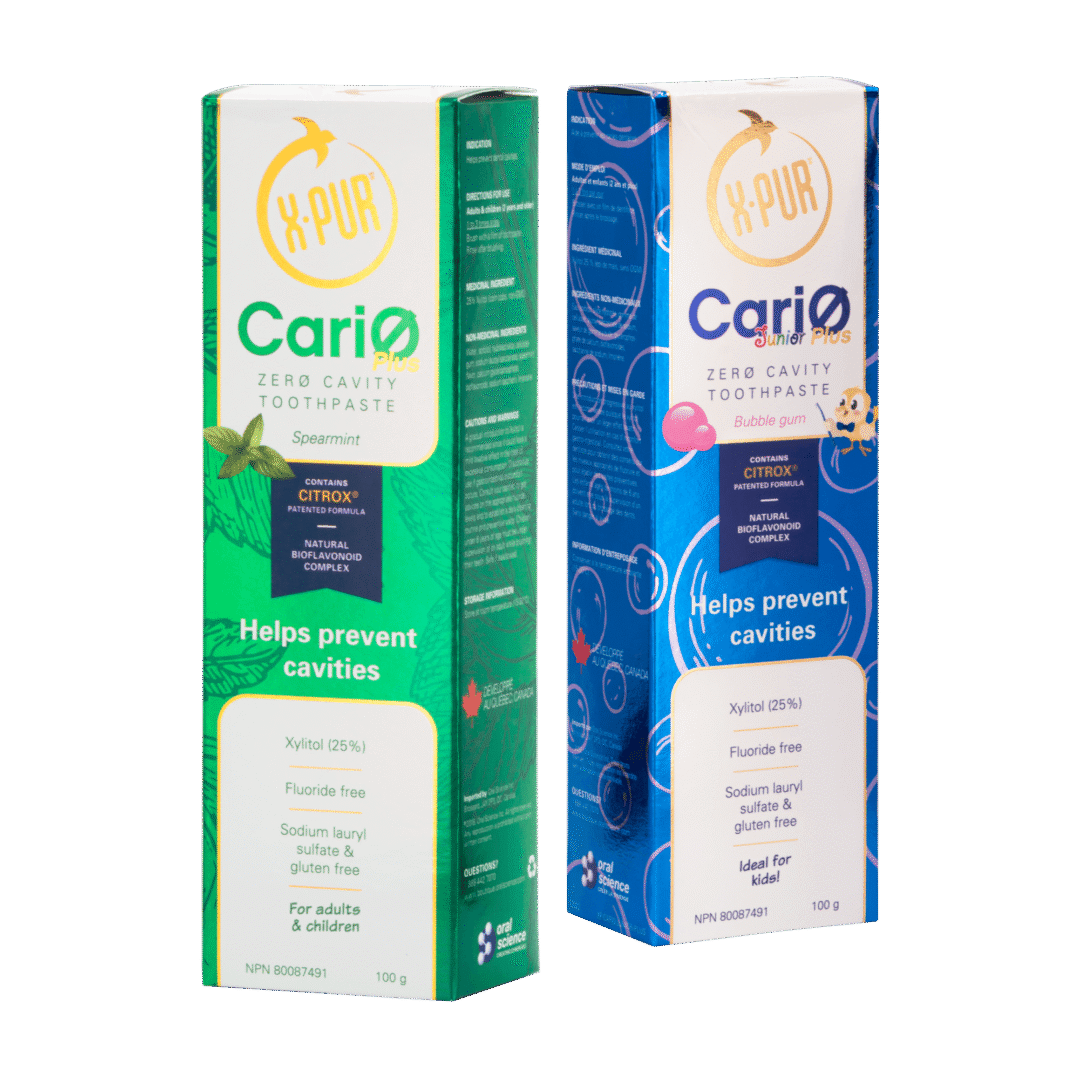
Cari0 is validated in vivo, is the most natural and ecological option (free of gluten, GMO, and sodium lauryl sulfate), and carries a Health Canada licence. Many competing xylitol toothpastes lack in-vivo evidence and, in some markets, an NPN.
Is it safe for infants/toddlers with newly erupted teeth, wiped on and off with gauze?
Yes. Xylitol wipes were previously recommended for 6-36-month-olds, and Cari0 is a suitable, very low-toxicity option for 0-3-year-olds. It can be applied on a wipe or directly by gentle brushing.
Is it safe for medically compromised patients as a leave-in treatment wiped away?
Yes. It is a safe choice for medically compromised or dysphagic patients. It’s ecological and natural with no urgency to wipe it away, and xylitol also stimulates saliva production, which is helpful since many medications are high in refined sugar.
Why choose Cari0 over a fluoride toothpaste?
Fluoride toothpastes have an average preventive fraction of about 34% and act late in the process (remineralization), and many highly infected patients don’t benefit from them. Cari0 has an average preventive fraction of about 60%, acts earlier by reducing cariogenic bacteria and changing the patient’s caries risk, improves topical fluoride effectiveness in high-risk patients, and is suitable for all ages (fluoride toothpastes have 0-3 limitations).
How long and how often should patients use Cari0?
For patients whose ongoing challenge is caries or periodontal disease, it can be used lifelong, and across the whole family to avoid cross-contamination. For a specific concern, use for at least three months, and it can be combined with a topical fluoride regimen.
How is Cari0 different from Remin, and does it replace it?
It doesn’t replace Remin. Cari0 is therapeutic and antibacterial, aimed at controlling the caries process; Remin is the optimal choice for remineralization (e.g. visible initial lesions) and also helps in xerostomia. They serve different roles.
If Cari0's antibacterial effect lasts at least six months, should I switch toothpastes after three months?
Don’t confuse the therapeutic and antibacterial effects. To prevent carious lesions, Cari0 remains the everyday choice. For an optimal sustained antibacterial effect, one approach is to use Cari0 for three months roughly every nine months.
Are cariogenic bacteria the same for root versus coronal caries?
Yes. Microbiological studies confirm mutans streptococci play a central role in initiating caries on smooth surfaces, fissures, and root surfaces, and can cause root caries; lactobacilli are important contributing bacteria whose role in initiating lesions is less well supported.
Are cariogenic bacteria the same as subgingival periodontal bacteria?
No, because caries and periodontal disease are different diseases with different microbiota. That said, Cari0 is the only product on the market with in-vivo evidence significantly reducing cariogenic bacteria regardless of site, and it also significantly reduced periodontal-disease bacteria in preliminary work.
Any contraindications?
None known, given the natural source and the small daily xylitol exposure (about 0.25 g per brushing; an adult would need to ingest 70-200 g/day before risking diarrhea). Documented cautions are limited to specific conditions such as birch allergy or diabetes. Patients with stable Crohn’s disease can use it safely, but it’s best avoided during active flares, as xylitol might worsen active inflammation.
Does xylitol reduce the amount of good bacteria?
No. Xylitol reduces cariogenic bacteria, not the overall bacterial flora. It is well established that xylitol targets mutans streptococci, and this research showed lactobacilli are specifically reduced too. By reducing cariogenic bacteria and preventing acid production, xylitol has no long-term harmful effect on flora.
How do you justify the small patient sample used to test Cari0?
Sample size relates to statistical power, not simply patient count. With a 60% difference between groups, fewer participants are needed to reach significance. The study groups exceeded 100 participants, which is sufficient for internal and external validity; small samples are only a concern when differences are small and clinically irrelevant.
Can bacteria develop resistance to xylitol?
Some studies suggest long-term xylitol consumption can select for xylitol-resistant mutans streptococci, but those used regimens of several grams per day. With a toothpaste delivering about 0.5 g/day, long-term resistance isn’t expected.
Does xylitol reduce cariogenic bacteria, or mutate them?
It reduces them. Xylitol cannot be fermented, so mutans streptococci can’t metabolize it, and their numbers decrease; there is no bacterial mutation. This decrease also creates room for mineral remineralization, explaining the indirect remineralizing effect.
Why does the box say to rinse when the protocol says not to?
The label matches box information Health Canada approved for a comparable earlier product. The correct scientific direction is not to rinse, because keeping the 25% xylitol in the mouth after brushing enhances effectiveness and is consistent with Remin, and it is safe if swallowed. However, there is no contraindication either way, so keeping it in the mouth should be presented as optional rather than a standard instruction.
How does Cari0 work against biofilm, and does it need a remineralizing agent like fluoride or hydroxyapatite?
Through xylitol, Cari0 disrupts the biofilm and significantly reduces cariogenic bacteria (S. mutans) in infants, children, and adults. This matters because remineralizing agents such as fluoride aren’t effective when infection is high (>=100,000 S. mutans/ml saliva), which is common in people with demineralization problems. Cari0 lowers bacterial load and creates the right conditions for remineralization. The recommended protocol is three months of Cari0, either alongside professional topical fluoride or before starting a remineralizing toothpaste, extended to the whole family to prevent cross-contamination.