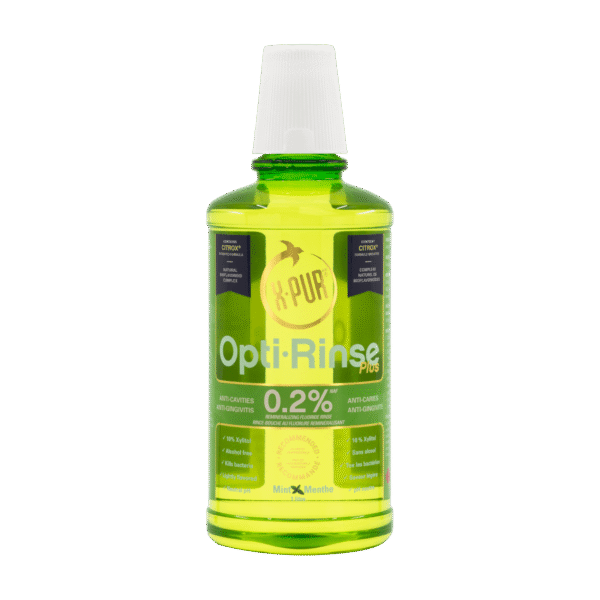
X-PUR Opti-Rinse Plus 0.2% Sodium Fluoride 1 L – Mint
$22.99
0.2% High Strength Sodium Fluoride Rinse
This product is currently out of stock and unavailable.
Antimicrobial, Anti-Gingivitis & Anti-Caries Oral Rinse
| Quantity | Unit price |
|---|---|
| 1+ | $22.99 |
| 3+ | $21.84 |
| 6+ | $20.69 |
Mechanism of action
A scientifically proven 4-ingredient patented formulation with CITROX®, 10% Xylitol, Cetylpyridinium Chloride, 0.05% Sodium Fluoride (225 ppm F) or 0.2% Sodium Fluoride (905 ppm F)
CITROX®
Antimicrobial patented complex
Plant-based biodegradable bioflavonoid complex offering a powerful antibacterial, antifungal, antiviral, antioxidant and anti-inflammatory effect.

Xylitol
Reduces cariogenic bacteria load
Cariogenic microorganisms cannot metabolize xylitol, which results in their inability to produce lactic acid or polysaccharide which causes caries.
Cetylpyridinium Chloride
Against gingivitis
A broad-spectrum antimicrobial agent that penetrates the cell membrane and causes cell components to leak, eventually leading to cell death.
Sodium Fluoride
Remineralizes against caries
Fluoride ions bind with the calcium and phosphate ions to form fluoroapatite to produce a surface more resistant to acid dissolution.
Indications
Anti-caries
Helps prevent and reduce
plaque and gingivitis

Helps to remineralize
tooth enamel
Benefits
Proven equivalent in antimicrobial potency as a chlorhexidine oral rinse but without the harsh side effects
CITROX® and CPC
Antibacterial, antiviral and antifungal
Anti-caries
Helps to remineralize tooth enamel
Efficient, multi-purpose, evidence-based oral rinse
Alcohol-free
Neutral pH
No comparable oral rinse on the market
Sweetened with 10% xylitol for a delightful and refreshing taste
Unique patented formulation with CITROX®: specific antibacterial bioflavonoid complex
Other clinical uses
Geriatrics
Orthodontics
Pediatrics
Proper oral hygiene
Tooth sensitivity
High-risk caries
Xerostomia
Directions for use
Adults and children aged 6 years and older
Regular treatment
Rinse with 10 mL for 1 minute once a day (0.05% formulation) or once a week (0.2% formulation). Expectorate. Do not eat, drink, or rinse for 30 minutes. Children under 6 years of age should consult with a dental professional.
High intensity treatment
Use the 0.2% formulation once a day until bottle is finished, for a one-month duration, or following the recommendation of a dental professional.
Research
Prepared by: Dennis Cvitkovitch PhD, Professor, Faculty of Dentistry, University of Toronto. September 12, 2021.
X-PUR® Opti-Rinse Plus is a preventative, non-prescription mouthrinse. It provides therapeutic benefits, and should be recognized for its potential use in-office as an effective Pre-Procedural Mouthrinse (PPMR), and recommended by today’s dental professional for oral self-care.
The Institute for Antiviral Research at Utah State University performed testing of X-PUR® Opti-Rinse Plus against the SARS-CoV-2 virus. Results confirmed that X-PUR® Opti-Rinse Plus 0.2% and X-PUR® Opti-Rinse Plus 0.05% were both cytotoxic to SARS-CoV-2 viral cells, and exhibited viricidal activity, reducing the virus below the limit of detection after a 1-minute contact time (LRV>1.9, >90%), equivalent to a 98.74% reduction. This demonstrates the ability of X-PUR® Opti-Rinse Plus to work as an effective PPMR.
Further research conducted at the Faculty of Dentistry at the University of Toronto with X-PUR® Opti-Rinse Plus 0.2% and the X-PUR® Opti-Rinse Plus 0.05% compared favorably to a prescription rinse containing .12% chlorhexidine for their ability to kill and/or inhibit several oral pathogens, including:
- Porphyromonas gingivalis, a proteolytic anaerobe associated with periodontal disease, that mainly affects adults by causing destruction of alveolar bone resulting in eventual tooth loss. This bacterium has also been shown to colonize distal organs including the heart1,2 and brain3, potentially causing systemic disorders including heart and Alzheimer’s disease
- Streptococcus mutans, the most common bacteria associated with the initiation of caries, predominant in childhood caries4
- Streptococcus sobrinus, an additional risk factor exacerbating caries activity4
- Lactobacillus casei, predominant in childhood caries6
- Candida albicans, positively associated with early childhood caries6,7, a comorbidity of hyposalivation8, predominant in long-term care residents with prostheses, and a risk factor for pneumonia9
After exposure to the full strength rinses for one minute, all three rinses demonstrated: a 3-log reduction (i.e. 99.9% killing) was detected against P. gingivalis; in C. albicans, there was at least a 4 log reduction (>99.99% killing); L. casei was killed with >99.999% efficiency; S. mutans showed at least 99% of the tested cells were killed; for S. sobrinus, no colonies were detected with any of the rinses for the exposure time detected (>99.999% killing).
In the natural environment of dental plaque, bacteria grow as a biofilm attached to the tooth surface. When the three rinses were tested against biofilm-grown cells, the most prominent effect was observed with P. gingivalis and X-PUR® Opti-Rinse Plus 0.2% treatment, with a 50% reduction in biofilm biomass after 10 minutes of exposure. With X-PUR® Opti-Rinse Plus 0.05%, there was a 40% reduction in biofilms, while the chlorhexidine rinse was only able to reduce biofilms by 10%.
X-PUR® Opti-Rinse Plus (0.05% & 0.2%) are proven mouth rinses for optimal outcomes.
References
- Radwan-Oczko M, Jaworski A, Dus I, Plonek T, Szulc M, Kustrzycki W: Porphyromonas gingivalis in periodontal pockets and heart valves. Virulence 2014, 5(4):575-580. PMC4063818 ↩︎
- Deshpande RG, Khan MB, Genco CA: Invasion of aortic and heart endothelial cells by Porphyromonas gingivalis. Infection and immunity 1998, 66(11):5337-5343. PMC108667 ↩︎
- Dominy SS, Lynch C, Ermini F, Benedyk M, Marczyk A, Konradi A, Nguyen M, Haditsch U, Raha D, Griffin C et al: Porphyromonas gingivalis in Alzheimer’s disease brains: Evidence for disease causation and treatment with small-molecule inhibitors. Sci Adv 2019, 5(1):eaau3333. PMC6357742 ↩︎
- Veena RL, Nagarathna C: Correlation of streptococcus mutans and streptococcus sobrinus colonization with and without caries experience in preschool children. Indian J Dent Res 2020, 31(1):73-79. ↩︎
- Reis ACM, Bezerra DDS, Hart-Chu ENS, Stipp RN, Guedes SFF, Neves BG, Rodrigues LKA: Quantification and gene expression of Lactobacillus casei group species associated with dentinal lesions in early childhood caries. Saudi Dent J 2021, 33(2):69-77. PMC7848803 ↩︎
- Sridhar S, Suprabha BS, Shenoy R, Suman E, Rao A: Association of Streptococcus Mutans, Candida Albicans and Oral Health Practices with Activity Status of Caries Lesions Among 5-Year-Old Children with Early Childhood Caries. Oral Health Prev Dent 2020, 18(1):911-919. ↩︎
- Ev LD, Dame-Teixeira N, Do T, Maltz M, Parolo CCF: The role of Candida albicans in root caries biofilms: an RNA-seq analysis. J Appl Oral Sci 2020, 28:e20190578. PMC7185980 ↩︎
- Buranarom N, Komin O, Matangkasombut O: Hyposalivation, oral health, and Candida colonization in independent dentate elders. PloS one 2020, 15(11):e0242832. PMC7688165 ↩︎
- Huang D, Qi M, Hu Y, Yu M, Liang Z: The impact of Candida spp airway colonization on clinical outcomes in patients with ventilator-associated pneumonia: A systematic review and meta-analysis. Am J Infect Control 2020, 48(6):695-701. ↩︎


Related products
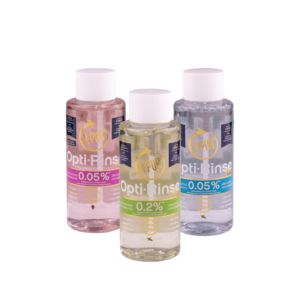
X-PUR Opti-Rinse Plus 60 mL Sample
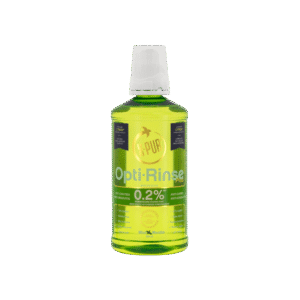
X-PUR Opti-Rinse Plus 0.2% Sodium Fluoride 500 mL – Mint
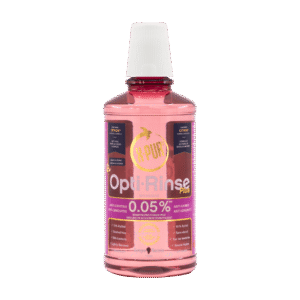
X-PUR Opti-Rinse Plus 0.05% Sodium Fluoride 1 L – Grape
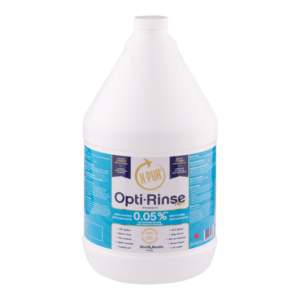
X-PUR Opti-Rinse Plus 0.05% Sodium Fluoride Pre-Procedural 4 L – Mint
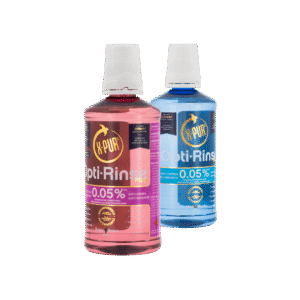
X-PUR Opti-Rinse Plus 0.05% Sodium Fluoride 500 mL
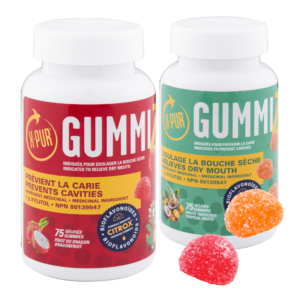
X-PUR GummiZ with Xylitol 75 Gummies
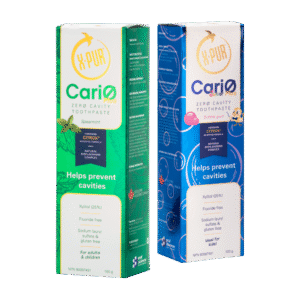
X-PUR CariØ Plus Toothpaste 100 g
Trusted by Our Customers
There are no reviews yet.