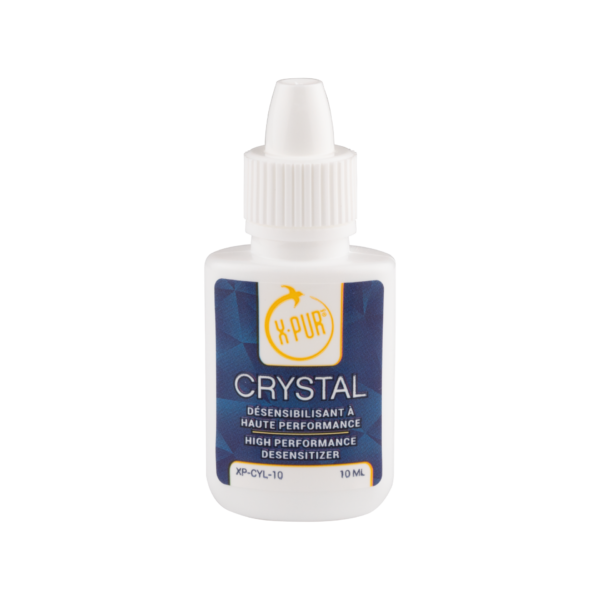
X-PUR Crystal In-Office Desensitizer 10 mL Bottle
$119.99
In-Office Desensitizer
This product is currently out of stock and unavailable.
Natural, Non-Toxic and Fast-Acting for High Performance
| Quantity | Unit price |
|---|---|
| 1+ | $119.99 |
| 2+ | $114.99 |
| 4+ | $109.99 |
X-PUR® Crystal is a water-based potassium oxalate in-office desensitizer made of natural acids and salts that quickly form insoluble calcium crystals. It provides effective patient relief for dentin hypersensitivity within seconds. This innovative blend rapidly blocks the fluid flow within dentinal tubules, reducing sensitivity. Unlike other desensitizers on the market, it does not require refrigeration and can be warmed for extra patient comfort. X-PUR® Crystal is efficient, cost-effective, and safe.
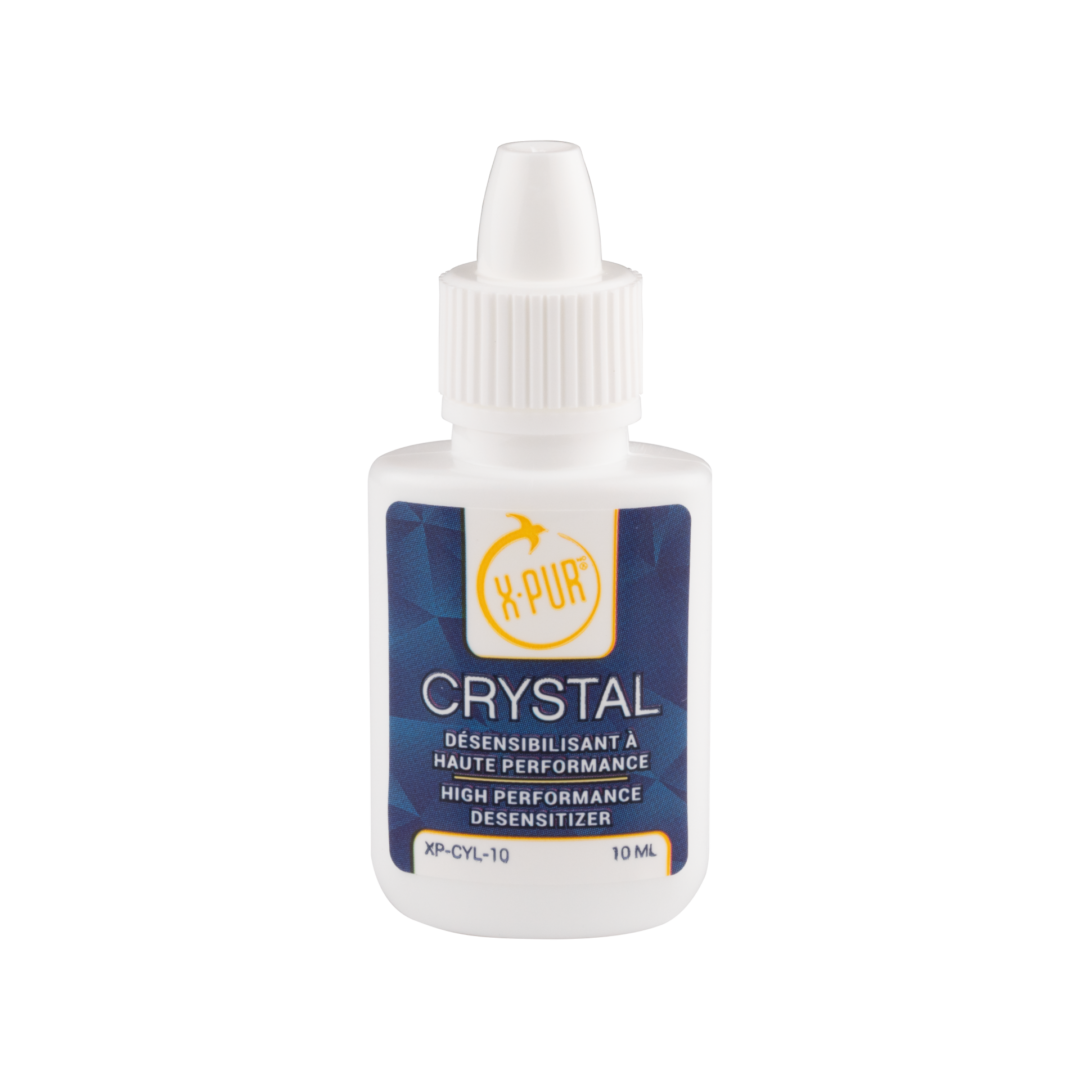
Mechanism of action
Enamel, dentin and cementum are composed of high concentrations of alkaline calcium hydroxyapatite (HAP). X-PUR Crystal® reacts with HAP to rapidly form millions of acid-resistant chelate precipitates within the dentinal tubules at depths of 7–12 μm. This action creates a long-lasting seal on the surfaces of the vital dentin substrate, preventing patient hypersensitivity and blocking bacteria penetration to the vital pulp.
Indications
Exposed cementum and dentin
Heavy calculus along the cervical neck that extends along the root surface
Pain from removal of an orthodontic bracket
Periodontal surgery
Prophylaxis: before and after
Rewetting agent
Temporization
Thermal sensitivity
Under restorations: amalgams, composites, crowns and veneers, inlays and onlays
Whitening: before and after
Benefits
Biologically compatible with soft-tissue — works and well after periodontal surgery
Can be used with any adhesive systems
Cost-effective: 10 mL bottle ≅ 320 drops; 1 site ≅ 2 drops ≅ $0.75 (based on a 10 mL bottle at $119.99)
Easy application: no drying, isolation or curing necessary
Glutaraldehyde and HEMA free: non-irritating and harm free to soft-tissues
Long-lasting, quick and easy application (20 sec. saturate + 20 sec. rest)
May enhance tissue reattachment
Prevents the migration of bacteria towards the vital pulp
Slows the demineralization process and promotes remineralization
Directions for use
Recession or abfraction areas
- Do not etch X-PUR Crystal® low pH formulation. X-PUR Crystal® is considered a self-etchant. It dissolves immediately, does not harm soft tissues, and removes the smear layer.
- Clean and rinse the area of all foreign debris of biofilm or other particles without a gauze. It is best to not dry as the product is hydrophilic.
Note: using a gauze to rub the area may desiccate the dentinal tubule. - Place 1–2 drop(s) for every 1–2 sites into a clean well of your choice or a dappen dish. You may need more drops depending on the size and number of teeth.
- Using a sterile micro brush, microsponge or small cotton pellet, soak the area and gently rub it onto the affected surface(s) for 20 seconds. Note: ensure to continually dip the brush into the liquid and rub into the area (back/forth) to thoroughly saturate the exposed area.
- Allow X-PUR Crystal® to naturally air dry only for 20 seconds.
Note: Keep the buccal and labial mucosa off the teeth after applying to aid in air drying. - If you do not experience the desired relief, you may perform a second or third application without any tissue damage.
Under a restoration or crown
- It is suggested not to etch under a restoration because of its low pH formulation. X-PUR Crystal® is considered a self-etchant which dissolves immediately and already removes the smear layer.
- If you want to etch: Etch, apply, prime, and bond.
- Place when all of the restorative drilling is completed.
- If you wish to place an adhesive restoration, place an acid etchant for only 5 seconds to remove the debris, then rinse and gently evacuate with light air dispersion of 1 second and at a distance of 5 cm.
- Apply X-PUR® Crystal onto all of the preparation surface as well as cavity walls and even onto the enamel around the cavity prep.
- Apply the X-PUR® Crystal with a microsponge brush and be sure to rub the agent all over the cavity prep surfaces: This is to ensure the agent contact is complete, to permit chelation of many millions of small nano-calcium oxalate acid resistant crystals to seal the dentinal tubules, as well as, to create a surface layer that does not diminish adhesive bond strengths.
- After 20 seconds of rubbing X-PUR® Crystal, do not rinse, but evacuate the area with gentle suction and 1 second air puffs from 5 cm distance.
Clinical tips
- An appearance of a frosty-white surface indicates the blockage of the dentin tubules.
- May be applied to a damp surface, dabbed around crown margins, and onto the exposed dental roots sensitive to cold or air stimuli.
- No light curing is necessary.
Superior Ingredients vs Other Products
Effect of desensitizing agents on dentin permeability and dentin tubule occlusion.1
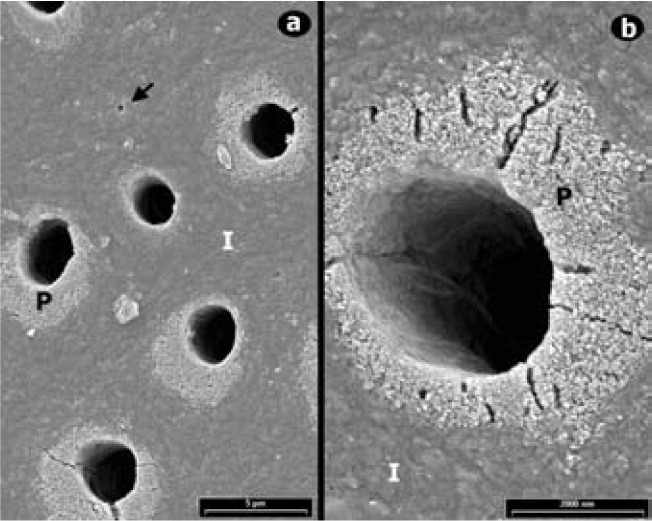
Scanning electron micrographs (SEM) of polished dentin. No smear layer or smear plugs are observed on the dentin. a. A lateral canal is observed within the intertubular dentin and is also devoid of smear-layer and plug (black arrow). P : Peritubular dentin; I: Intertubular dentin. Micron bar figure a. = 5μm. Micron bar figure b. = 2μm.
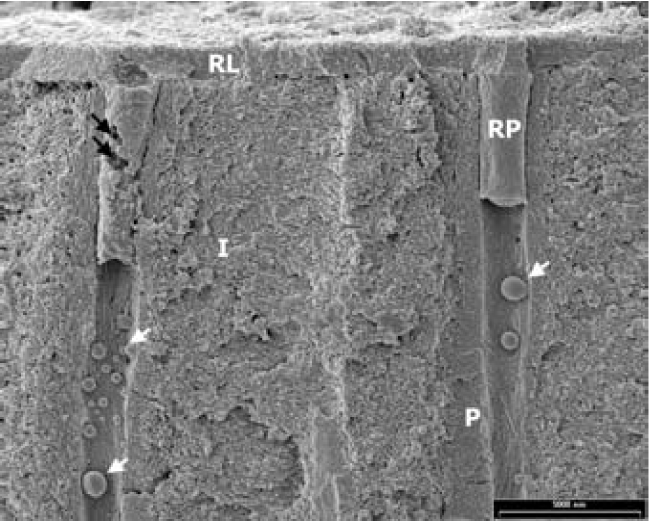
SEM of Seal and Protect, fractured specimen. A resin layer (RL) covers the surface and infiltrates the tubules with a resin plug (RP). Globular structures are present below the RP within the dentinal tubules (white arrows). The RP occluding the tubule shows a pocket formation (black arrows). P : Peritubular dentin; I: Intertubular dentin. Micron bar = 5μm.
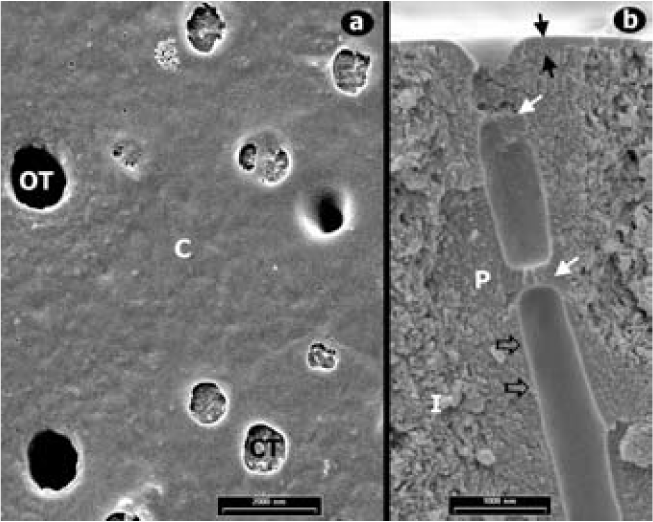
SEMs of Gluma: a. Top surface. A thin coat (C) is seen over the dentin. Some of the tubules appear to be open (OT) and some appear closed (CT). Micron bar = 2μm. b. Fractured specimen. A thin coat covers the dentin surface (black arrows) it extends within the tubules covering the walls (black open arrows) and forming bridges between them (white arrows). P : Peritubular dentin; I: Intertubular dentin. Micron bar = 1μm.
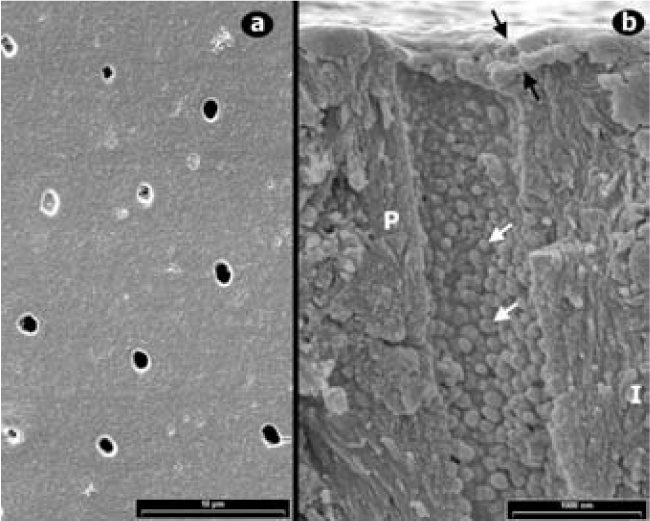
SEMs of HurriSeal: a. Top surface. Most of the dentinal tubules appear to be open. Micron bar = 10μm. b. Fractured specimen. A coat covers the dentin surface (black arrows). Globular structures are present within the dentinal tubules (white arrows). P : Peritubular dentin; I: Intertubular dentin. Micron bar = 1μm.
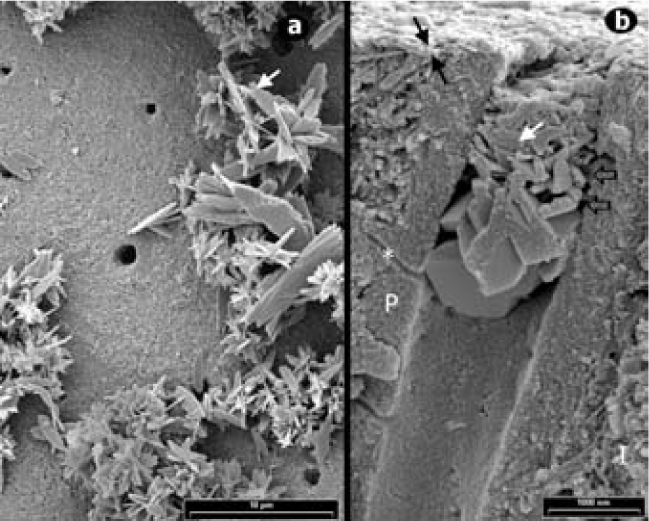
SEMs of D/Sense 2: a. Top surface. A crystal precipitate (white arrow) is seen covering part of the dentin. Tubules that can be seen appear open. Micron bar = 10μm. b. Fractured specimen. A thin coat covers the dentin surface (black arrows). Within the tubule crystals (white arrow) form a fairly dense mass, yet do not appear to be attached to the tubules (black open arrows). An open lateral canal free of crystals is marked with a white asterisk. P : Peritubular dentin; I: Intertubular dentin. Micron bar = 1μm.
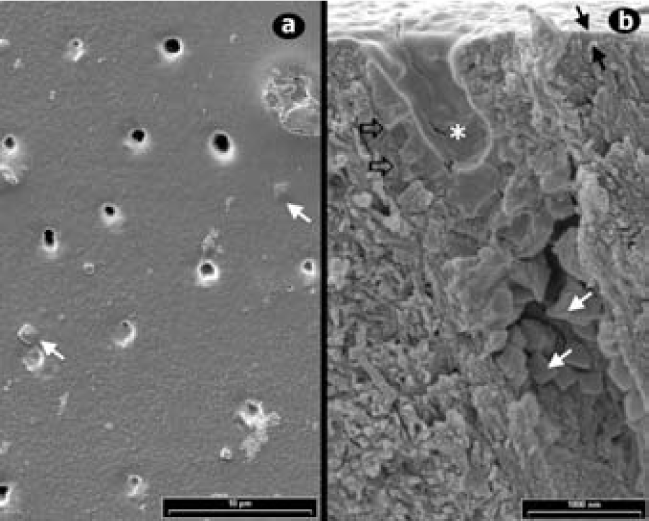
SEMs of X-PUR® Crystal: a. Top surface. About half of the dentinal tubules appear to be closed. A few crystals are apparent on the dentin surface (white arrow). Micron bar = 10μm. b. Fractured specimen. A thin coat covers the dentin surface (black arrows) and invaginates (white asterisk) into the dentinal tubule. Below the invagination crystals have formed a dense mass (white arrows) and have intimate contact with the dentin wall (open black arrows). Micron bar = 1μm.
References
- Justine L. Kolker / Marcos A. Vargas / Steven R. Armstrong / Deborah V. Dawson, J Adhes Dent. 2002 Fall;4(3):211-21. ↩︎


Related products
Trusted by Our Customers
There are no reviews yet.